Necrosis Pathology Study Guide

Caseous Necrosis
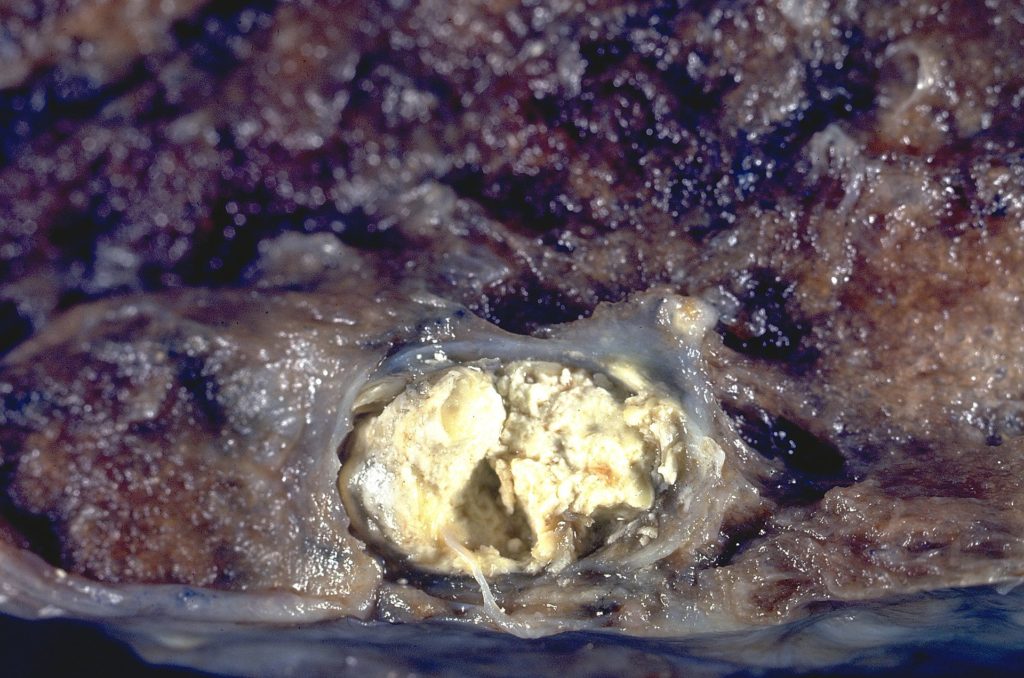
Caseous Necrosis. Initial (primary) infection with Mycobacterium. tuberculosis in an immunocompetent individual usually occurs in an upper region of the lung producing a sub-pleural lesion called a Ghon focus. Granulomatous involvement of peribronchial and/or hilar lymph nodes is frequent in primary tuberculosis due to lymphangitic spread from the Ghon focus. The early Ghon focus together with the lymph node lesion constitute the Ghon complex. These lesions undergo healing and over time usually evolve to fibrocalcific nodules. The combination of late fibrocalcific lesions of the lung and lymph node which evolved from the Ghon complex is referred to as the Ranke complex. This image provides a good example of "caseous necrosis" The "cheesy" appearance of the necrosis is due to incomplete proteolytic digestion of the necrotic tissue and is apparent only on gross or macroscopic examination. The terms "caseous", "caseating" and "caseation" are often used erroneously to describe the microscopic appearance of necrotizing granulomas. Yale Rosen. Not altered. CC BY-SA 2.0

Necrosis

Necrosis Pathology Video

Necrosis is the premature pathologic death of cells in living tissue.

Acute inflammation can result in the death of a large group of cells which will cause necrosis.

Necrosis is always pathologic.

Necrosis is never physiologic.

The patterns of necrosis include:

  • Coagulative necrosis
  • Liquefactive necrosis
  • Gangrenous necrosis
  • Fat necrosis
  • Caseous necrosis

Coagulative Necrosis

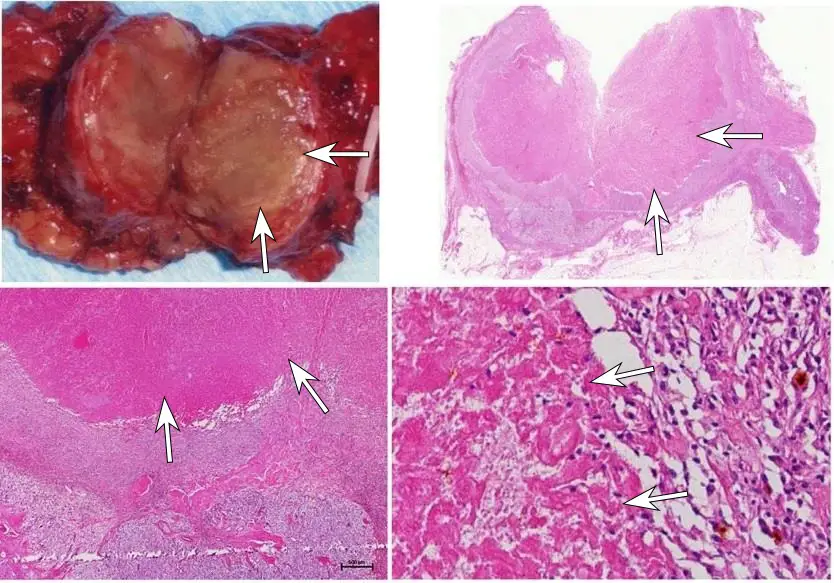
In coagulative necrosis the necrotic tissue remains firm, end organ structure is maintained, and even cellular structure is maintained; however the nuclei disappear.

Ischemic infarctions are known to cause coagulative necrosis in most tissues.

Infarctions may be wedge shaped.

After an ischemic infarction if blood is reintroduced to loosely organized tissue a red infarction may occur.

Note the lack of tiny blue nuclei in necrotic tissue.

Coagulative necrosis does not happen in the brain (liquefactive necrosis will occur).
Coagulative Necrosis
Coagulative Necrosis. Histopathology of a pheochromocytoma with coagulative necrosis, displayed at gross pathology (upper left) and light microscopy at low (upper right), medium (lower left) and high magnification (lower right). Nobumasa Ohara, Yasuyuki Uemura, Naomi Mezaki, Keita Kimura, Masanori Kaneko, Hirohiko Kuwano, Katsuya Ebe, Toshio Fujita, Takeshi Komeyama, Hiroyuki Usuda, Yuto Yamazaki, Takashi Maekawa, Hironobu Sasano, Kenzo Kaneko & Kyuzi Kamoi – (2016). “Histopathological analysis of spontaneous large necrosis of adrenal pheochromocytoma manifested as acute attacks of alternating hypertension and hypotension: a case report”. Journal of Medical Case Reports 10 (1). Not altered. CC BY 4.0. This article is distributed under the terms of the Creative Commons Attribution 4.0.

Liquefactive Necrosis

After a brain infarction the proteolytic enzymes that originate from microgliosis will cause hydrolysis and liquefication of the brain parenchyma.

In an abscess, the proteolytic enzymes released from the neutrophils will liquefy the tissue.

In pancreatitis, the proteolytic enzymes that originate from the pancreas will liquefy the pancreas.
Liquefactive Necrosis
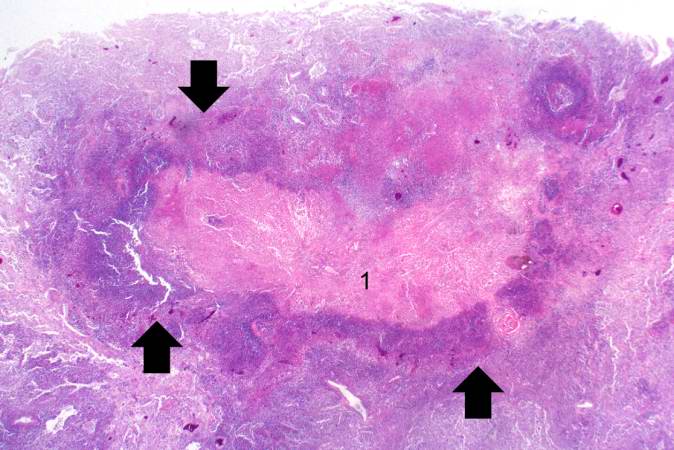
Liquefactive Necrosis. This is a low-power photomicrograph of lung tissue containing a large abscess. The center of the abscess contains necrotic debris (1) and there is a rim of viable inflammatory cells (arrows) surrounding this abscess.Image courtesy of Professor Peter Anderson DVM PhD and published with permission © PEIR, University of Alabama at Birmingham, Department of Pathology. Not altered. CC

Gangrenous Necrosis

Gangrenous necrosis results from a lack of blood supply that leads to lack of oxygen reaching a tissue that leads to cell death and tissue damage.

There are multiple types of gangrenous necrosis to be aware of, which include:

  • Dry gangrene
  • Wet gangrene
  • Gas gangrene
  • Internal gangrene
  • Necrotizing fasciitis
  • Fournier gangrene

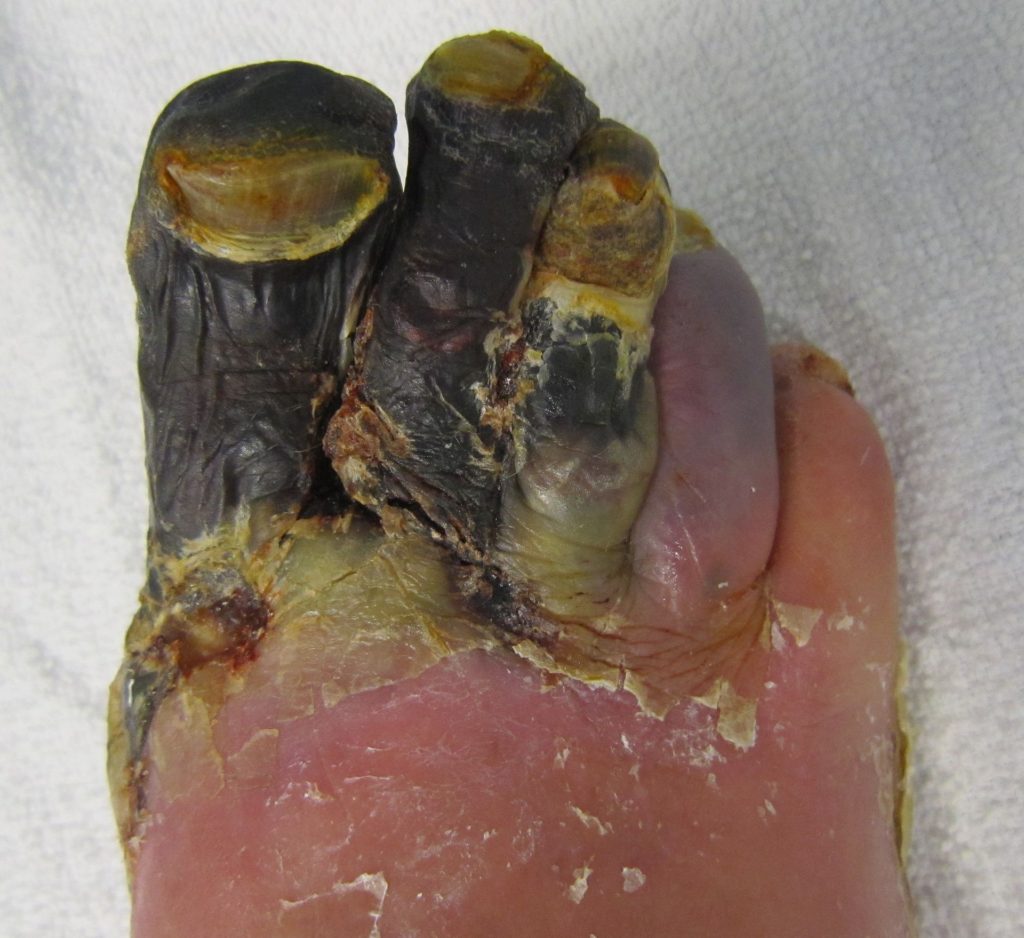
Dry gangrene is a form of coagulative necrosis that resembles mummified corpses, which usually effects the distal appendages.

Wet gangrene is gangrenous necrosis that is infected by bacteria that promote liquefactive necrosis.

Gas gangrene is a medical emergency due to gangrenous necrosis that is infected by bacteria that produce gas (such as Clostridium perfringens).

Internal gangrene is gangrene that occurs when blood flow to an internal organ is blocked (such as an incarcerated hernia).

Necrotizing fasciitis is also known as flesh eating disease, and is a type of aggressive coagulative necrosis with superimposed infection by group A streptococcus (GAS) bacteria that effect the skin and fascia.

Fournier gangrene is a type of necrotizing fasciitis that usually affects the male genitals and groin region.
Gangrenous Necrosis
Gangrenous Necrosis. Gangrene of the 1st to 4th toes of the right foot in person with diabetes. James Heilman, MD. Not altered. CC BY-SA 3.0

Caseous Necrosis

Caseous necrosis has the appearance of a congealed cheese.

The most tested form of caseous necrosis involves the granulomas of the lungs associated with tuberculosis.
Caseous Necrosis
Caseous Necrosis. Initial (primary) infection with Mycobacterium. tuberculosis in an immunocompetent individual usually occurs in an upper region of the lung producing a sub-pleural lesion called a Ghon focus. Granulomatous involvement of peribronchial and/or hilar lymph nodes is frequent in primary tuberculosis due to lymphangitic spread from the Ghon focus. The early Ghon focus together with the lymph node lesion constitute the Ghon complex. These lesions undergo healing and over time usually evolve to fibrocalcific nodules. The combination of late fibrocalcific lesions of the lung and lymph node which evolved from the Ghon complex is referred to as the Ranke complex. This image provides a good example of “caseous necrosis” The “cheesy” appearance of the necrosis is due to incomplete proteolytic digestion of the necrotic tissue and is apparent only on gross or macroscopic examination. The terms “caseous”, “caseating” and “caseation” are often used erroneously to describe the microscopic appearance of necrotizing granulomas. Yale Rosen. Not altered. CC BY-SA 2.0

Fat Necrosis

Fat necrosis is the necrosis of adipose tissue that results in the deposition of calcium.

Fat necrosis typically has a greasy, chalky white appearance.

Saponification is the biochemical reaction associated with fat necrosis.

Saponification results in a type of dystrophic calcification.

In dystrophic calcification, necrotic tissue serves as a nidus that calcification may build upon.

Classical causes of fat necrosis are:

  • Pancreatitis (fat necrosis of peri-pancreatic fat, along with liquefactive necrosis of pancreatic tissue due to free pancreatic enzymes)
  • Trauma to adipose tissue such as the breast

Metastatic calcification and dystrophic calcification are two completely separate entities.

The difference between metastatic and dystrophic calcification are:

  • Metastatic calcification is deposition of calcium in normal tissue due to excessive calcium levels in the system
  • Dystrophic calcification is deposition of calcium in pathologic tissues
Fat Necrosis
Fat Necrosis. Breast lump showing an area of fat necrosis showing shadowy outlines of necrotic adipocytes surrounded by an inflammatory reaction with cholesterol clefts [H&E stain 4X] Department of Pathology, Calicut Medical College – Calicut Medical College. Not altered. CC BY-SA 4.0

Fibrinoid Necrosis

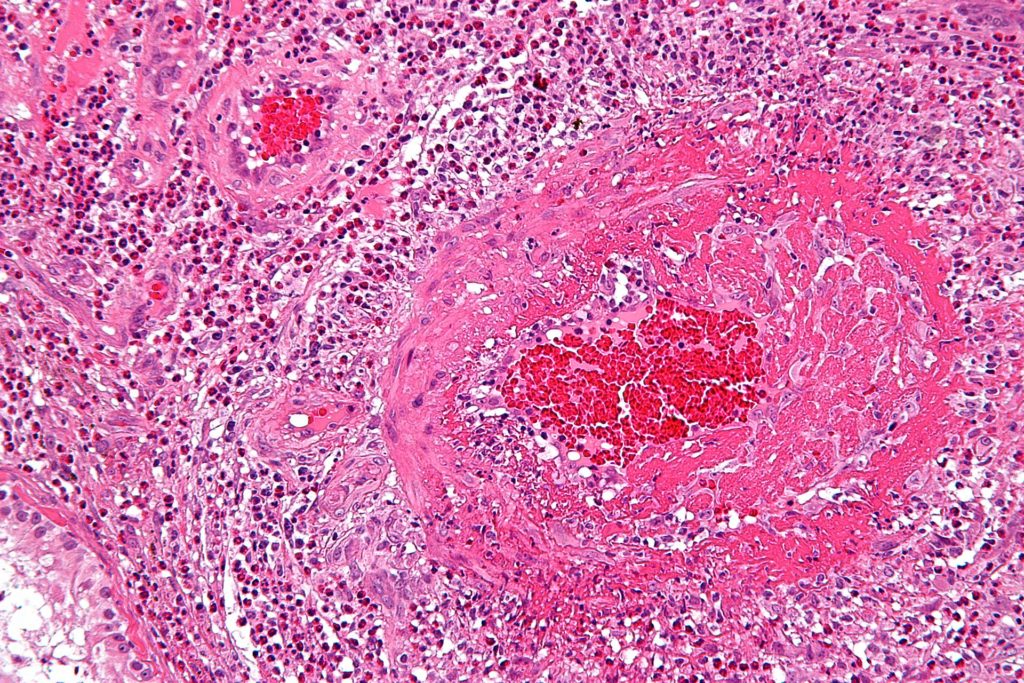
Fibrinoid necrosis is necrosis associated with fibrin deposition in blood vessel walls.

Necrotic damage to blood vessel walls may result in fibrinoid necrosis.

Fibrin may leak into the vessel wall resulting in a bright pink deposit that can be visualized microscopically on the vessel wall.

Fibrinoid necrosis is a feature of malignant hypertension, vasculitis, and in the placenta due to pre-eclampsia.

Fibrinoid Necrosis
Fibrinoid Necrosis. Micrograph showing (intensely pink) fibrinoid necrosis (large blood vessel – right of image) in a case of vasculitis (eosinophilic granulomatosis with polyangiitis). Eosinophilic vasculitis consistent with Churg-Strauss syndrome, abbreviated CSS. H&E stain. CSS is characterized by: Granulomas. Asthma. Fever. Eosinophilia. Nephron. Not altered. CC BY-SA 3.0