Posterior Pituitary Gland Pathology Video
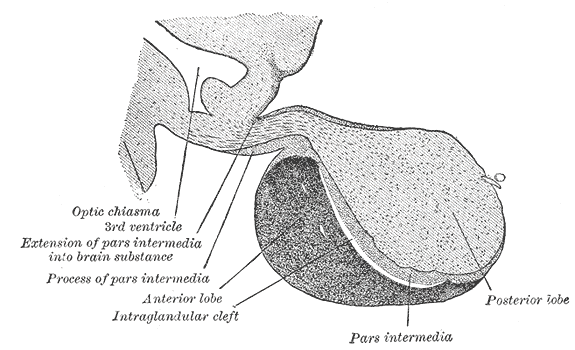
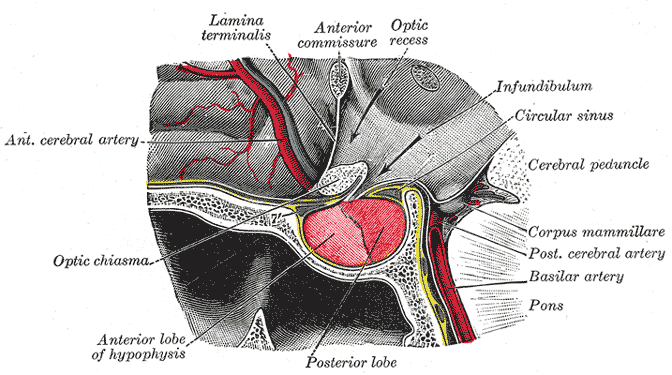
Posterior Pituitary Gland
The hypothalamus produces oxytocin and antidiuretic hormone (ADH), which are subsequently sent by axons to the posterior pituitary for release.
The distal tubules and collecting ducts of the kidney are affected by antidiuretic hormone (ADH), which encourages free water retention.
The release of breast milk (let-down) in breastfeeding mothers and the contraction of the uterus during childbirth are both mediated by oxytocin.
Posterior gland pathology includes:
- Central diabetes insipidus
- Nephrogenic diabetes insipidus
- Syndrome of inappropriate ADH secretion (SIADH)
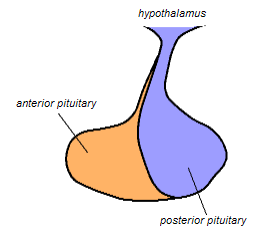 Posterior Pituitary Gland. Pituitary gland illustration by Diberri. Not altered. CC BY-SA 3.0
Central Diabetes Insipidus
Central diabetes insipidus results from anti-diuretic hormone (ADH) deficiency.
Central diabetes insipidus occurs due to hypothalamic or posterior pituitary pathology such as:
- Tumors
- Trauma
- Infections
- Inflammation
Clinical characteristics of central diabetes insipidus include:
- Polyuria
- Polydipsia
- Dehydration
- Hypernatremia
- Low urine osmolality and specific gravity
Central diabetes insipidus is diagnosed by failure of a water deprivation test to raise urine osmolality.
Central diabetes insipidus is treated with desmopressin (an antidiuretic hormone (ADH) analog).
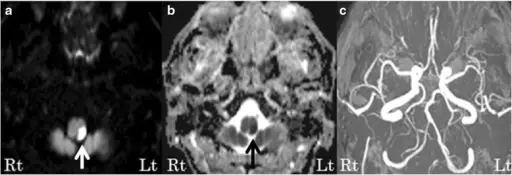 Magnetic resonance imaging (MRI) and MR angiography findings. a, b Diffusion-weighted magnetic resonance imaging (DWI) showed the hyperintensity in the left dorsolateral medulla (a, white arrow) with hypointensity on apparent diffusion coefficient (ADC)-map (b, black arrow). c MR angiography demonstrated no obvious occlusion. Syndrome of inappropriate secretion of antidiuretic hormone (SIADH) associated with lateral medullary syndrome: case report and literature review. Nakano H, Yanase D, Yamada M - BMC neurology (2016). Not Altered. CC.
Nephrogenic Diabetes Insipidus
Nephrogenic diabetes insipidus is due to impaired renal response to ADH.
Common causes of nephrogenic diabetes insipidus include:
- Inherited mutations
- Lithium
- Demeclocycline
Desmopressin has little effect despite having clinical characteristics that are comparable to those of central diabetes insipidus.
- Magnetic resonance imaging (MRI) and MR angiography findings. a, b Diffusion-weighted magnetic resonance imaging (DWI) showed the hyperintensity in the left dorsolateral medulla (a, white arrow) with hypointensity on apparent diffusion coefficient (ADC)-map (b, black arrow). c MR angiography demonstrated no obvious occlusion. Syndrome of inappropriate secretion of antidiuretic hormone (SIADH) associated with lateral medullary syndrome: case report and literature review. Nakano H, Yanase D, Yamada M - BMC neurology (2016). Not Altered. CC.
Syndrome of Inappropriate ADH (SIADH) Secretion
Syndrome of inappropriate of ADH (SIADH) secretion is due to excessive ADH secretion.
Causes of syndrome of inappropriate of ADH (SIADH) secretion include:
- Small cell lung cancer is most frequently brought on by ectopic production
- Central nervous system injury
- Pulmonary infection
- Medications such as cyclophosphamide
Symptoms of syndrome of inappropriate of ADH (SIADH) secretion include:
- Hyponatremia and low serum osmolality
- Mental status changes
- Seizures
Hyponatremia results in neuronal swelling and cerebral edema.
Treatment of syndrome of inappropriate of ADH (SIADH) secretion includes:
- Free water restriction
- Demeclocycline
- Magnetic resonance imaging (MRI) and MR angiography findings. a, b Diffusion-weighted magnetic resonance imaging (DWI) showed the hyperintensity in the left dorsolateral medulla (a, white arrow) with hypointensity on apparent diffusion coefficient (ADC)-map (b, black arrow). c MR angiography demonstrated no obvious occlusion. Syndrome of inappropriate secretion of antidiuretic hormone (SIADH) associated with lateral medullary syndrome: case report and literature review. Nakano H, Yanase D, Yamada M - BMC neurology (2016). Not Altered. CC.