Cell Death
The hallmarks of cell death is loss of the cell nucleus.
The mechanism of nuclear loss in cell death includes:
- Pyknosis
- Karyorrhexis
- Karyolysis
Pyknosis means nuclear condensation.
Karyorrhexis means fragmentation.
Karyolysis means dissolution.
There are two mechanisms for cell death which include:
- Apoptosis
- Necrosis
Apoptosis
Apoptosis means “the falling of leaves” in Greek.
Apoptosis is programmed cell death.
Apoptosis utilizes ATP.
Examples of apoptosis include:
- Removal of cells during embryogenesis
- Endometrial shedding during the menstrual cycle
Apoptosis is also utilized by CD8+ T-cell mediated killing of virally infected cells.
Cells that are undergoing apoptosis appear eosinophilic (pink).
Apoptosis is mediated by caspases that activate proteases and endonuclease.
The proteases breakdown the cytoskeleton.
The endonuclease cleaves cellular elements.
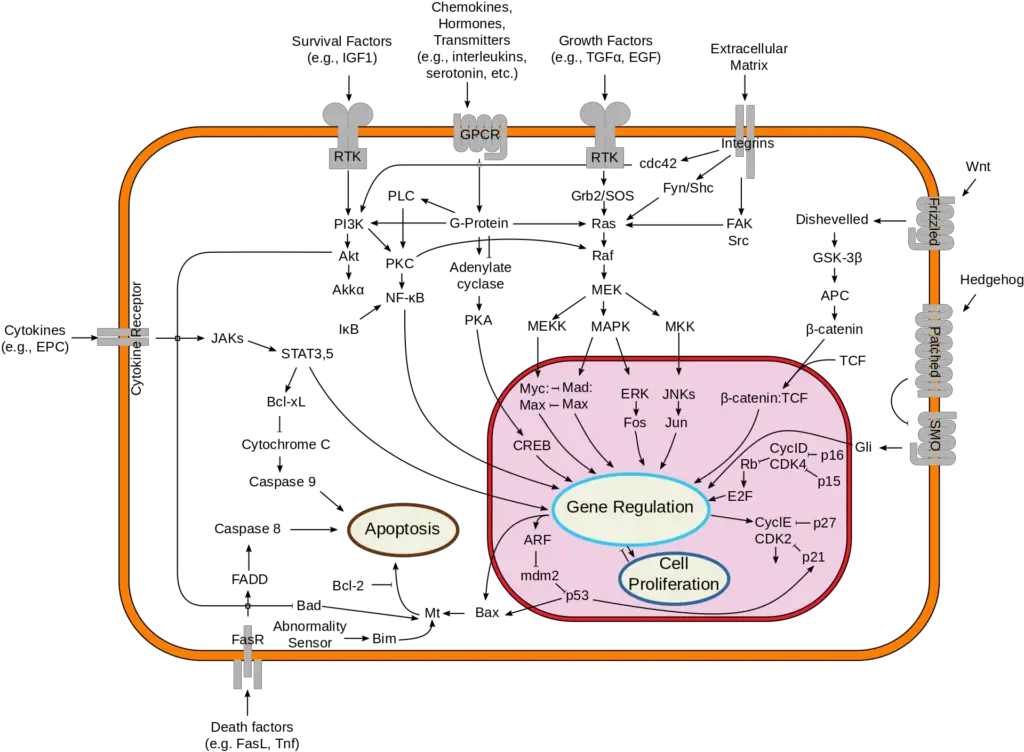
Caspases are activated by three pathways which include:
- Intrinsic mitochondrial pathway
- Extrinsic receptor-ligand pathway
- Cytotoxic and T-cell mediated pathway

Intrinsic Mitochondrial Pathway
BLC2 inhibits apoptosis.
In the intrinsic mitochondrial pathway BCL2 is inactivated due to cellular injury, DNA damage, or loss of humoral stimulation.
Cytochrome C leaks from the inner mitochondrial matrix into the cytoplasm and activates caspases because pCO2 does not stop the cytochrome C from entering the inner mitochondrial matrix.
Extrinsic Receptor-Ligand Pathway
In the extrinsic receptor ligand pathway, FAS ligand binds FAS death receptor (CD95) on the target cell which activates the caspases.
Tumor necrosis factor (TNF) is also involved by binding the TNF receptor on target cells, which leads to activation of caspases.
The extrinsic receptor ligand pathway is utilized by your immune system regarding negative selection of T lymphocytes in the thymus.
Cytotoxic CD8+ T-cell Mediated Pathway
T-cells create pores on the membrane of target cells utilizing perforin.
T cells send granzymes through the pores which enters the targeted cell and activates caspases.
Caspase activation within the targeted cells leads to their demise.